
In November 1983 NATO held a command post exercise which rehearsed new procedures for a nuclear first strike on the Soviet Union by NATO, which was held following a very tense year in US-Soviet relations and used a new cryptographic system. The 1988 publication of The Storm Birds, wherein Gordon Brook-Shepherd interviewed Gordievsky, Able Archer was introduced to the public consciousness.[1] Since then, and perhaps earlier within the US government, a debate has emerged as to whether this moment came close to triggering a pre-emptive Soviet nuclear attack, following their “launch on warning” doctrine. For all they knew, the argument goes, Able Archer ’83 was merely cover for a genuine nuclear attack.
So how close was it? The crisis is often compared to the Cuban Missile Crisis of 1962, which involved much more direct and hostile confrontation, and genuine active plans to attack Soviet positions in Cuba. However, the case of Able Archer depends largely on writers who have anchored on a single source: Oleg Gordievsky himself. But there are inconsistencies in Gordievsky’s account and potentially corroborating evidence tends to be both scarce and problematic.
According to journalist and historian Nathan Jones, Gordievsky provided “truly alarming evidence of Soviet paranoia: a massive intel collection effort that assumed a U.S. first strike was in the works and focused on indicators of imminent attack.”[2] He traces this argument to a matter of timing. After the Able-Archer exercise, Reagan recorded in his dairy the possibility that the Soviets were genuinely scared of the United States. In between the events: Gordievsky had reported to his British handlers a flash telegram reporting an important indicator of US intentions: “an alert on US bases.”[3] This was an indicator prescribed by the KGB’s collection programme known as RYaN: Raketno-Yadernoe Napadenie, or nuclear missile attack. While often presented as paranoid RYaN was both thorough and largely consistent our own indicators and warning practice.[4] The KGB sought indicators in CONUS and around the world of US preparations for a first strike. These included things like senior NSC meetings, unusual work patterns at the US Department of State, Pentagon, CIA; blood drives, the relocation of POTUS (President of the United States) to secure locations, coordination between NATO leaders, or even the use of new procedures or encryption systems.
Gordievsky certainly passed on details about RyAN.[5] I am also willing to believe that around this time, he was able to translate the above-mentioned flash telegram to his handlers as evidence of Soviet paranoia, or more reasonably, that the Soviets were genuinely afraid of an American first-strike. Moreover, I am willing to believe that these reports influenced Reagan’s diary entry, noted by Jones. However, the first formal admission by US intelligence that Soviet paranoia was genuine came only in 1990, with the President’s Foreign Intelligence Advisory Board’s study on the topic.[6]
Gordievsky was, however, one human source feeding into a much larger and more nuanced all-source intelligence picture. So what did that all-source picture look like? The data on this are actually better for the American side than the Soviet. Leonard Perroots was Deputy Chief of Staff for intelligence at US Air Forces at Ramstein in November 1983 and noticed certain indications. Despite months of reassurance that there was no evidence of Soviet intention to strike NATO, Perroots received signs during Able Archer of raised readiness and alert in Soviet nuclear and air forces. Perroots chose to act upon his instinct and did not recommend any response in kind.[7] Perroots prompted the PFIAB study on his way out as director of DIA in 1989. For all we know, due to the timing, Perroots could have also been inspired by Gordievsky. Perroots and the PFIAB doubted the IC’s judgement that, in 1983 Moscow was not preparing for a military confrontation. The JIC was even more relaxed, allegedly.[8] As Michael Herman put it, during the Cold War, intelligence “provided important reassurances to Western governments. Washington was not going to be Pearl Harbor-ed overnight.” Simultaneously, on the Soviet side, intelligence confirmed leaders’ preconceived notions “in ways that emphasized Western hostility.”[9]
Apparently, Soviet officials interviewed after the Cold War could not even name Able Archer even though they could recall the Autumn Forge, the Reforger 83 field exercise which preceded it by two months. Simon Miles has argued that not only was Able Archer not a war scare, but Soviet leaders were not being paranoid.[10] Miles also argued that Gordievsky’s recollection linking RYaN and Able Archer has received disproportionate attention because of the way it has circulated in the literature. Indeed, Gordievsky’s version of events was the first. His publication of RYaN instructions with Christopher Andrew has underpinned the majority of discussion on the topic. There is a meaningful difference between what he says about RYaN and what he says about Able Archer. The former comes with documentary evidence, unlike the latter, but academics and journalists treat both with the same weight.[11] Much the same is true of Soviet penetration agent Rainer Rupp’s 2007 account to the documentary 1983: Brink of Collapse. When his controller requested information about NATO nuclear activity Rupp told them it was not preparing a first strike during the exercise. It is a bit too convenient to take credit for saving the world just seven years after he was released from prison, serving a treason conviction.
Gordievsky said on other occasions that RYaN was not taken that seriously within the KGB. Other sources support this. General Andrian Danilevich, could only generalise about the tension of the period and dismissed the acute threat in November 1983. Sergei Akhromeev, deputy chief of the Soviet General Staff in 1983, said later on that it was unlikely that the general staff would “brief a KGB officer on such secrets [about the state of alert], especially if he was posted to a western embassy… [Gordievsky] told such stories to improve his standing in the west.”[12] Akhromeev and other Soviet sources were hardly impartial toward Gordievsky, so it is difficult to know what to believe. The Czechoslovak StB and Stasi could each name Able Archer, and accurately described it as a “command post exercise.”[13] So were the Soviets reassured, or ignorant? It is possible that these officials do not remember Able Archer because memory is fickle, or because it was a blip in an otherwise volatile and tense year. Either way, I find Miles convincing. We were not close to Armageddon, and Gordievsky’s supposed influence over western understanding of Soviet paranoia needs to be put into perspective of the otherwise reassuring intelligence picture. Documentary evidence could change my mind, but I think those Soviet generals couldn’t name Able Archer because it didn’t matter to them. .
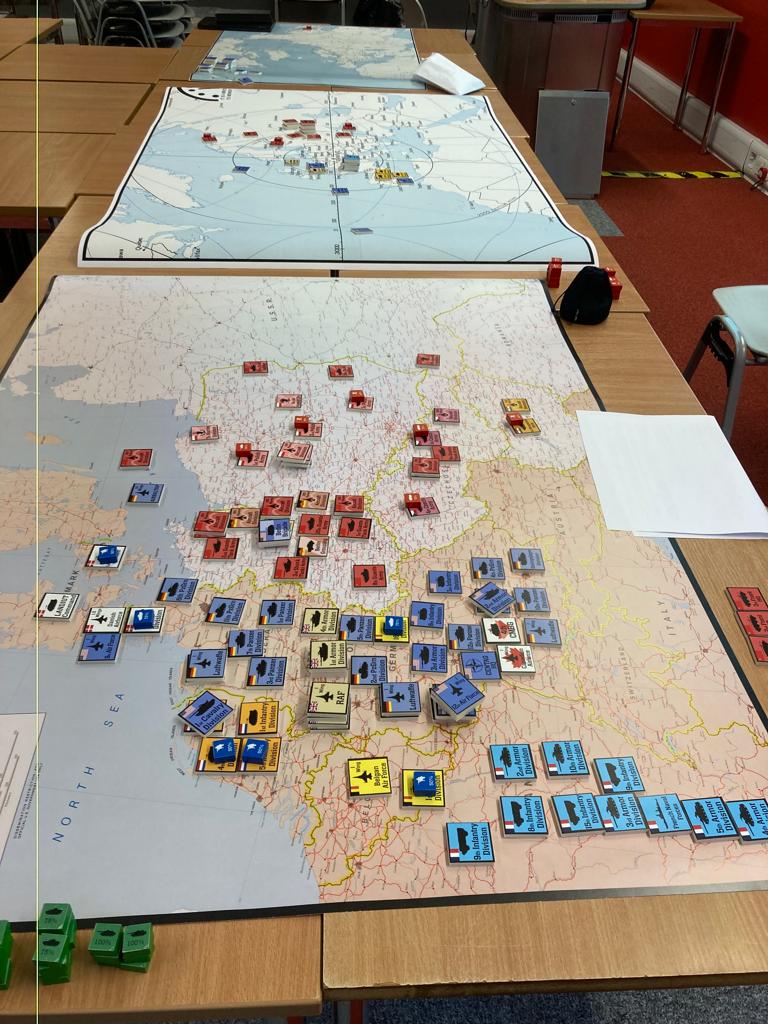
Synthetic evidence, generated through a classroom wargame modelling the crisis, shows that the soviets likely were reassured, not ignorant.
In our MA Intelligence and Security Studies programme, my students game out Able Archer ’83 as a case study using a double-blind tabletop exercise. In each iteration so far, the Soviet team looks at their warning model, nourished by RYaN and rightly concludes something along the lines of “although something is up, there is no reserve mobilisation or unusual activity in CONUS”. Their consistent response has been to raise the readiness of their own air and nuclear forces, and no more. To be sure, we have no concrete evidence about the quality of Soviet indicators and warning intelligence, or its product. However, the organised thought experiment of our wargame leads me to believe that, despite RYaN’s quirks, the KGB and GRU had a competent analytic process. Of course, the argument is counterfactual, and it’s just a game, but so far, we have not destroyed the world and have not yet found conditions which could plausibly have allowed that to happen.
[1] Simon Miles, “The War Scare That Wasn’t: Able Archer 83 and the Myths of the Second Cold War,” Journal of Cold War Studies 22, no. 3 (August 1, 2020): 93, https://doi.org/10.1162/jcws_a_00952.
[2] Nate Jones, Able Archer 83: The Secret History of the NATO Exercise That Almost Triggered Nuclear War (New Press, The, 2016), x.
[3] Jones, 3.
[4] For a recent and fairly thorough discussion of I&W see John Gentry and Joseph Gordon Strategic Warning Intelligence (Georgetown University Press, 2019) ch.6.
[5] Christopher M Andrew and Vasili Mitrokhin, The Mitrokhin Archive: The KGB in Europe and the West (London: Allen Lane, 1999), chap. 13.
[6] Jones, Able Archer 83, 44; Thomas Fraise and Kjølv and Egeland, “Able Archer: How Close of a Call Was It?,” Bulletin of the Atomic Scientists 79, no. 3 (May 4, 2023): 157, https://doi.org/10.1080/00963402.2023.2199577.
[7] Jones, Able Archer 83, 56–57.
[8] Miles, “The War Scare That Wasn’t,” 96 see also fn 39.
[9] Michael Herman, “What Difference Did It Make?,” Intelligence and National Security 26, no. 6 (December 1, 2011): 886–901, https://doi.org/10.1080/02684527.2011.619802.
[10] Miles, “The War Scare That Wasn’t.”
[11] for an example of how this trend persists see Gordon Barrass, “Able Archer 83: What Were the Soviets Thinking?,” Survival 58, no. 6 (November 1, 2016): 7–30, https://doi.org/10.1080/00396338.2016.1257176; Christopher M. Andrew and Oleg Gordievsky, Comrade Kryuchkov’s Instructions: Top Secret Files on KGB Foreign Operations, 1975-1985 (Stanford University Press, 1993).
[12] Miles, “The War Scare That Wasn’t,” 116; Documents found at “Series of Five Interviews with Colonel General Andrian A. Danilevich by John G. Hines, December 18, 1990 to December 9, 1994, in Soviet Intentions 1965-1985: Volume II Soviet Post-Cold War Testimonial Evidence, by John G. Hines, Ellis M. Mishulovich, of BDM Federal, INC. for the Department of Defense, Office of Net Assessment. Unclassified with Portions ‘Retroactively’ Classified. | National Security Archive,” accessed April 7, 2025, https://nsarchive.gwu.edu/document/17326-document-25-series-five-interviews; and “The Soviet Side of the 1983 War Scare | National Security Archive,” accessed April 7, 2025, https://nsarchive.gwu.edu/briefing-book/aa83/2018-11-05/soviet-side-1983-war-scare.
[13] Miles, “The War Scare That Wasn’t,” 115 see note 147.
 Intelligence Studies Review
Leave a comment